Category: An Interesting Case

  • The Case of the Dog and the Divorcees

    Written by Michael Tillmann in An Interesting Case

    This is the interesting case of the Dog and the Divorcees, or to use its correct legal name, the case of Thompson v. Thompson. It is the story of a married couple, Mr. Thompson and Mrs. Thompson, and their border collie Charlie. When the couple separated, Mr. Thompson ended up keeping Charlie to live at his home, but a dispute ensued over ownership of the dog. This led Mrs. Thompson to seek out the help of the court system.

    May 5, 2024 · 6 min read

    The Case of the Dog and the Divorcees

    This is the interesting case of the Dog and the Divorcees, or to use its correct legal name, the case of Thompson v. Thompson.

    It is the story of a married couple, Mr. Thompson and Mrs. Thompson, and their border collie Charlie. When the couple separated, Mr. Thompson ended up keeping Charlie to live at his home, but a dispute ensued over ownership of the dog. This led Mrs. Thompson to seek out the help of the court system.

    The case was decided in British Columbia Supreme Court in 2005, but the story begins five years earlier.

    In 2000, Mr. and Mrs. Thompson were living together as a married couple in British Columbia. On a day in February of that year, the pair went to a pet store and came home with their new companion, Charlie the border collie. The couple and the dog then lived together in the same home until December 2003, when Mr. and Mrs. Thompson separated.

    After the separation, Charlie mostly lived in the home of Mr. Thompson, except for a brief visit where he stayed with Mrs. Thompson.

    At some point, a dispute developed between Mr. and Mrs. Thompson over who was the rightful owner of Charlie and who he should live with. It appears it could not be resolved amicably, and Mrs. Thompson started a small claims lawsuit in the Provincial Court of British Columbia. This suit went to trial before Judge Takahashi on August 19th, 2005.

    At the trial’s start, Judge Takahashi noted that it was possible the Provincial Court was not the proper venue to decide the matter. This was because, under the British Columbia Family Relations Act, property obtained by a couple during marriage is matrimonial property and, if the relationship later ends and there is a dispute over the property, the matter is supposed to be dealt with in Supreme Court. However, for the sake of expediency, the judge agreed to deal with the matter as long as both parties were aware of the situation and agreed to proceed, which they did.

    As the trial proceeded, Mr. Thompson argued the dog was his because he was the one who had paid the pet store in 2000, he was the one who paid for the dog’s food and veterinary care, and the dog lived with him. Mrs. Thompson’s counterargument was that the dog was hers because it had been purchased and given to her as a birthday gift in 2000. In addition, she stated she also looked after Charlie and took him to the vet, and it was not exclusively Mr. Thompson who did this.

    Different versions came out during the trial over where and how Charlie was purchased in 2000. According to Mr. Thompson, Charlie had been purchased by himself and he produced a bill of sale from a store as evidence. However, Mrs. Thompson testified that Charlie had been obtained as a trade rather than as a cash purchase – as Mr. and Mrs. Thompson had operated a business together at the time and had offered the pet store some services from their business in exchange for the dog.

    In the cross-examination phase of the trial, each party received a chance to question and challenge each other on testimony they had given. It was here that Mrs. Thompson alleged that Mr. Thompson had left two messages on her telephone answering machine, attempting to pressure her to drop her lawsuit. Mr. Thompson denied leaving the messages and so Mrs. Thompson asked the judge for permission to play the tapes, which the judge granted. As the tapes were about to be played, Mr. Thompson stated that he’d never heard them before.

    In one of the messages played that day in the courtroom, a man’s voice could be heard telling Mrs. Thompson she would lose her lawsuit because the man had proof the dog was his, in the form of a bill of sale from a particular pet store. In the other message, the man told Mrs. Thompson that there was no point in continuing the lawsuit because Charlie had been struck and killed by a vehicle.

    Now, as it turns out, the dog thankfully was not actually struck by a vehicle and was alive and well. Additionally, the dog had never been purchased from the pet store mentioned during the phone call, but rather had been obtained from a different store; and at the trial Mr. Thompson admitted as much, since he had presented a bill of sale from this different store as evidence to support his own case.

    Mrs. Thompson argued that the tapes were proof that Mr. Thompson was being dishonest. He had falsely claimed to have a bill of sale from the first store, and then after learning the dog was from the second store, fabricated documentation from that store. Further, she argued he had lied about the dog’s death to have Mrs. Thompson drop her lawsuit.

    Mr. Thompson responded that the voice on the tapes was not his, denying the validity of the evidence.

    After hearing the evidence and the arguments and counterarguments, Judge Takahashi decided to reserve his judgement, retiring to consider his decision.

    Three days later, on August 22nd, 2005, the judge handed down his decision. He ruled that, despite the denials, he was satisfied the voice on the phone message tapes was that of Mr. Thompson, and that the bill of sale he had presented as evidence was false. In conclusion, he ruled in favour of Mrs. Thompson that Charlie was hers and should be returned to her. He also awarded her costs for traveling to pick up the dog and, in October 2005, awarded her a further $1,000 in punitive damages because Mr. Thompson had fabricated evidence.

    Mr. Thompson was not prepared to accept this legal defeat, and so he immediately filed an appeal to the British Columbia Supreme Court. This appeal was heard before Justice Rogers on November 14th, 2005.

    On appeal, Mr. Thompson claimed that the Provincial Court judge had made several errors that justified overturning his decision. One of these alleged errors was that Judge Takahashi should not have allowed the audio tapes into evidence, because they had not been disclosed to Mr. Thompson before the trial. Normally, in civil proceedings each party is required to disclose its evidence to the other side in advance, to avoid a party being ambushed with “surprise” evidence they have not prepared for. There were some other arguments from Mr. Thompson as well, but that was probably the most consequential.

    In the end, Mr. Thompson’s protests were not successful. With regards to his objection about the admission of the audio tapes, Justice Rogers ruled against Mr. Thompson and stated he should have objected to their admission at trial if he had a problem with not receiving them before trial. The justice noted that Mr. Thompson knew he had the right to object to the admission of evidence, because the judge had asked him earlier in the trial if he objected to some documents being admitted without prior disclosure.

    His other arguments on appeal were likewise not fruitful, and Justice Rogers dismissed Mr. Thompson’s appeal and confirmed that Mrs. Thompson was the rightful owner of Charlie. The justice also confirmed the $1000 in punitive damages and awarded Mrs. Thompson further costs for the expenses she had incurred to fight Mr. Thompson’s appeal.

    So, what does this case tell us? Well, for one that the breakdown of relationships can lead to messy legal disputes, but that is probably not surprising news to most people. But it also demonstrates that, under Canadian law, animals are treated the same as other property during divorce proceedings. Judges will look for who has the best property rights claim to a pet to determine who should keep the animal; and in the Thompson case it was Mrs. Thompson because the court found that it had been given to her as a gift.

    Caselaw shows that, except for a few outlier cases, Canadian judges have not treated companion animals in the same way as children. They will not issue orders for shared custody or consider what the impacts on the animal may be when reaching their decisions.

    However, this may be beginning to change, at least in British Columbia.

    As of January 2024, amendments to the province’s Family Relations Act were brought into force that now give judges a mandate to consider things, other than just pure property rights, when deciding disputes over pets in matrimonial proceedings. The amendments state that judges must now consider any history of animal cruelty, or threats of animal cruelty, as well as who is best able to care for the animal and any emotional attachment that children of the relationship have for the animal. However, the law still prohibits judges from awarding joint custody of pets. Possession must be granted entirely to one party or the other, unless they reach a voluntary out-of-court settlement agreeing to joint possession.

    SOURCES:

    Legislative Assembly of British Columbia. (2023, April 3). Bill 17 – 2023: Family Law Amendment Act, 2023. Legislative Assembly of British Columbia. https://www.leg.bc.ca/parliamentary-business/legislation-debates-proceedings/42nd-parliament/4th-session/bills/third-reading/gov17-3

    Breder, R. (n.d.). Changes to B.C.’s Family Law Act Include Pet Custody Provisions. BarTalk (December 2023 Issue). https://www.cbabc.org/BarTalk/Articles/2023/December/Features/Changes-to-B-C-%E2%80%99s-Family-Law-Act-Include-Pet-Custo

    Gertsoyg & Company. (n.d.). Divorce Pet Custody in Canada. Gertsoyg & Company, Comprehensive Legal Services. https://www.yglaw.ca/family-lawyer-vancouver/divorce-pet-custody-canada/

    Richter Trial Lawyers. (n.d.). Fighting over Fluffy: Who Gets to Keep the Family Pet? Richter Trial Lawyers. https://richtertriallaw.com/2021/04/29/family_pet/

    Thompson v. Thompson, 2005 BCSC 1604 (CanLII), <https://canlii.ca/t/1ptsd>, retrieved on 2024-02-10

  • The Case of the Problematic Poodle – Part 1

    Written by Michael Tillmann in An Interesting Case

    Part one of our three part blog series exploring legal cases related to a Poodle named Charlie and his owners, and how they repeatedly came into conflict with other persons, animals and the law.

    April 12, 2024 · 9 min read

    The Case of the Problematic Poodle - Part 1

    This is the interesting case of the Problematic Poodle – Part 1 or, to use its correct legal name, the case of the R v. Sisett.  It is a case dealing with a full-size Poodle named Charlie, his owners (those being an Ian Sisett and a Marguerite Sisett) and how they came into conflict with other persons, animals, and the law.  The case involving Charlie was decided by the Provincial Court of British Columbia in 2021, but the associated events began over a year earlier.

    On the morning of January 29th, 2020, Ian Sisett took his three Poodles – Charlie, Diva, and Biscuit – out from his home in the city of Kelowna, British Columbia with the aim of giving them some exercise. It should be noted here that these Poodles were not small dogs (as some Poodles can be), but rather were standard Poodles, which the American Kennel Club states normally are at least 15 inches tall at the shoulder and normally weigh 40-70 lbs, depending on their sex.  According to the court records of the litigation that would later ensue, Mr. Sisett described the size of one of the dogs – Charlie – as being “giant.”

    Mr. Sisett and his dogs travelled to the campus of Okanagan College, to use one of the fields to allow the animals to exercise off-leash there.  He had been there on previous occasions, and the security guards at the college campus were familiar with Mr. Sisett and reportedly allowed him to have his dogs off-leash there.  In fact, when Mr. Sisett was present on the campus that morning, sometime between 6:00am and 8:00am, one of the campus security guards on duty was a tenant of Mr. Sisett, who would later testify at the trial.

    The field that Mr. Sisett and his dogs made use of that day was an open grass field and it was not enclosed by a fence.  On the edge of the field was located a public street and a public sidewalk.  As it happened, on that morning as Mr. Sisett exercised his dogs on the campus of Okanagan College, another person was also walking their dog nearby.  This was Ms. Melanie Michaels, who was taking Spike – a small dog weighing under 10 lbs. – for a walk along that very sidewalk that ran adjacent to the field.

    Fatefully, at the very time that Ms. Michaels was passing by the field, Mr. Sisett was in the course of playing fetch with his three Poodles, throwing a ball for them to chase.  It happens that this ball somehow left the field and ended up in the public street.  Around the same time, the three dogs of Mr. Sisett approached the street and the sidewalk that ran alongside it, the sidewalk that Ms. Michaels and Spike were on.

    Ms. Michaels perceived the three Poodles as charging towards her in an unsafe manner, so she began waving at them, to chase them away from her.  This succeeded for two of the dogs.  Indeed, one of those two ended up running into the street, presumably after the ball which had gone astray there.  A woman who was driving by the field observed the dog running into the street ahead of her, so she honked her horn and applied her vehicle’s brakes, to avoid this dog.

    As the passing motorist was stopping to avoid a collision, Ms. Michaels was now dealing with Charlie, Mr. Sisett’s third Poodle, who had not been scared off by Ms. Michael’s waving and had continued to approach her.  Charlie closed his mouth around Ms. Michaels’ smaller dog Spike and began to violently shake him.  Spike began screaming as he was shaken, and Ms. Michaels kicked at Charlie to defend Spike and compel Charlie to release his grip on the dog.  Ms. Michaels would later state she was not sure if her kicks contacted Charlie but, in any case, the Poodle did release Spike.

    The woman who had been driving by had these events and stopped, exiting her vehicle and coming over to help Ms. Michaels.  Spike began to make a noise that Ms. Michaels stated she had never heard the animal make before.  Meanwhile, Mr. Sisett called his three Poodles back to him, loaded them into his pickup truck and departed the scene.  He did not make any attempt to communicate with Ms. Michaels.

    In the days that followed, Ms. Michaels took three steps in response to the events of January 29th. I will go over these, in no particular order, as I don’t know what she order took them in.

    For one, Ms. Michaels took Spike to a veterinarian for treatment, and reportedly was informed that Spike’s jaw and molar were broken.  He reportedly required two surgeries and his jaw had to be wired shut to allow for healing.  But even after this, his jaw was permanently twisted, resulting in him no longer being able to eat hard food.  The total costs of veterinary treatment added up to $6,030.72.

    Secondly, Ms. Michaels reported the incident of January 29th to the animal control service of the Regional District of Central Okanagan.  Upon receiving the report, an animal control officer began an investigation and ended up being able to identify Mr. Sisett as the owner of Charlie.  Based on the evidence collected in the investigation, which consisted largely of the statement of Ms. Michaels and the statement of the passing motorist, the animal control officer decided to issue Mr. Sisett with a $1000 ticket for an offence under Regional District of Central Okanagan Bylaw #1343, that being the Responsible Dog Ownership Bylaw.  To be specific it was a ticket for an offence against Section 36 of the bylaw, which read: “No person shall cause or permit his or her dog to become a Dangerous Dog.”

    Thirdly, Ms. Michaels began to search for the identity of Charlie’s owner.  She went to the security office of Okanagan College to make enquiries a few days after the incident.  The security guard who was Mr. Sisett’s tenant informed the Sisetts of this visit by Ms. Michaels and, when Ms. Michaels returned on another day, the guard handed her an envelope on behalf of the Sisetts. Inside, there was a note written by Mrs. Sisett and $200.  The note apologized for the incident, stating that the owners of the dog from the incident (which was Charlie, although the dog was not named in the note) were working on his misbehaviour and stated the $200 was to cover any veterinary expenses.  Mrs. Sisett did not sign the note and there were no names or contact information contained in the note.

    The note evidently did not satisfy Ms. Michaels, as she continued to try to identify Charlie’s owners.  She participated in an interview with Global News about the incident and she also made posts on Facebook.

    Mr. Sisett was apparently offended by statements that Ms. Michaels had made in her interview and online postings, because one year after the incident – in January 2021 – he engaged the services of a lawyer to send her a cease-and-desist letter.  The letter alleged Ms. Michaels’ statements were defaming Mr. Sisett and directed her to remove the Facebook posts and the online story at Global News, and provide an apology letter, or else face a possible lawsuit.  Interestingly, it was the letter from Mr. Sisett’s lawyer that allowed Ms. Michaels to identify him, as her earlier efforts to do so had not proven fruitful.

    Mr. Sisett also disputed the $1000 ticket that had been issued to him by the animal control officer and the matter was assigned to the courts for a determination.  The case took a year before going to trial in February 2022 in the Provincial Court of British Columbia.  The trial was presided over by a Judicial Justice of the Peace, a judicial official in Canadian courts that handles trials and other hearings that do not merit being dealt with by a judge.  In this matter, the presiding Judicial Justice was B. Burgess.

    At his trial, Mr. Sisett alleged bias and impropriety by the animal control officer who issued the ticket, the Regional District government and the lawyer acting as prosecutor on behalf of the Regional District.  Mr. Sisett also argued that his dog Charlie had never bitten Ms. Michaels’ dog and suggested that Ms. Michaels might have caused her dog’s injuries herself, when she was kicking at Charlie.  Additionally, Mr. Sisett argued that it was not legally proper for him to be held liable for his dog allegedly being dangerous when the dog had no prior history of aggressive incidents, and he had no reason to believe the dog was dangerous.

    With regards to the allegations of bias that Mr. Sisett raised, it cannot be known with certainty, but it may be that previous dealings which Mr. Sisett had with the Regional District’s animal control service may have coloured his view of those bodies.  Indeed, Mr. Sisett and/or his wife Mrs. Sisett had previously been issued several tickets for dogs other than Charlie running at large contrary to animal control bylaws and had written letters to local newspapers to complain about what they perceived as unfair treatment. 

    In one instance, the Sisetts had challenged two tickets issued for their dogs being loose and running at large and had been successful, having the two tickets thrown out by the Supreme Court of British Columbia in 2019.  One of the dogs from these previous tickets, named Oso Grande, had sadly been struck by a vehicle during the time it was running loose, which ultimately led to him being euthanized due to his injuries. Indeed, in his letter to a local newspaper, Mr. Sisett commented how the fact he received a ticket for an incident where his dog ended up dying was offensive.

    After hearing from the witnesses and considering the evidence at trial over three days in February and June 2021, Judicial Justice Burgess gave his judgment on July 12th, 2021.  He dismissed Mr. Sisett’s accusations of improper conduct against the government, the prosecutor, and the animal control officer, declaring there was no evidence to support them.  He then went on to declare that, despite Mr. Sisett’s attempts to raise doubt, he was satisfied that Charlie had bitten Spike and that this was the cause of his serious injuries.

    In his judgment, Judicial Justice Burgess made some unfavourable findings against the credibility of Mr. Sisett.  At one point in his decision, the justice wrote that, although Mr. Sisett had argued in court that his dog was not responsible for injuring Spike, the fact that his wife had offered $200, and an anonymous apology note to Ms. Michaels was evidence to the contrary.  Additionally, he pointed out that, at one point in his testimony, Mr. Sisett had argued he knew nothing serious had happened because he had seen no blood on the ground, and the justice commented that Mr. Sisett would have had no way of being able to see this since he had been approximately 75 to 100 yards away at the time.

    The Judicial Justice also criticized Mr. Sisett’s behaviour after the dog bite incident, noting that he left the scene without checking on or communicating with Ms. Michaels and commenting that he believed this was done to avoid consequences.

    As for Mr. Sisett’s arguments about not knowing his dog was dangerous, the Judicial Justice dismissed this as well.  He found that the offence against section 36 of the bylaw was a strict liability offence which meant that, unlike with a traditional offence where intent or knowledge is required, once the prohibited act (the injury) had been proven, it was up to the defendant to show they had exercised due diligence to prevent the act or else be found guilty.  The justice’s opinion was that, since Mr. Sisett had been allowing his dog to run off leash – which was prohibited by the bylaw – this amounted to him “causing or permitting” Charlie to become a dangerous dog, as described in the bylaw.  Accordingly, Judicial Justice Burgess convicted Mr. Sisett and upheld the $1000 fine that had been stipulated on his ticket.

    And here ends Part 1 of our story, but it is not over, because Mr. Sisett did not take this conviction lying down.  He appealed his conviction to the Supreme Court of British Columbia.  If you want to know how that played out, please check out Part 2 of this series.

    SOURCES:

    Potenteau, D. (2020, February 8). Kelowna woman seeking video help after pet dog allegedly attacked by poodle. Global News. https://globalnews.ca/news/6526240/kelowna-pet-dog-attacked-poodle/

    Regional District of Central Okanagan Responsible Dog Ownership Bylaw No. 1343, 2014 (Consolidated). https://www.rdco.com/en/your-government/resources/Bylaws/BL1343-Consolidated-Regulate-License-Control-Responsible-Dog-Ownership-2023.pdf

    R. v Sisett (2021, July 12), Kelowna M-1 4908-1 (BCPC). https://govlaw.ca/wp-content/uploads/2023/06/Regina-v-Sisett-Reasons-for-Judgment-Filed-July-12-2021.pdf

    Sisett, I.R. (2019, February 9). Kelowna dog ownership only for the elites [Letter to the editor]. Kelowna Capital News. https://www.kelownacapnews.com/opinion/letter-kelowna-dog-ownership-only-for-the-elites-3175990

    Sisett, I.R. (2015, May 10). Pet owner asks for fairness, common sense from dog control [Letter to the editor]. The Daily Courier. https://www.kelownadailycourier.ca/opinion/letters_to_editor/article_4cb58d1a-f778-11e4-8409-0b768a25cede.html

    Sisett, I.R. & Sisett, M. (2015, May 20). Pet unfriendly By-laws [Letter to the editor]. Castanet. https://www.castanet.net/news/Letters/140298/Pet-unfriendly-By-laws

    Sisett v Central Okanagan (Regional District), 2019 BCSC 2091 (CanLII). https://canlii.ca/t/j3sdd

    The American Kennel Club, Inc. (n.d.). Poodle (Standard). American Kennel Club. Retrieved March 29, 2024 from https://www.akc.org/dog-breeds/poodle-standard/

  • The Case of the Problematic Poodle – Part 2

    Written by Michael Tillmann in An Interesting Case

    Part two of our three part blog series exploring legal cases related to a Poodle named Charlie and his owners, and how they repeatedly came into conflict with other persons, animals and the law.

    April 12, 2024 · 5 min read

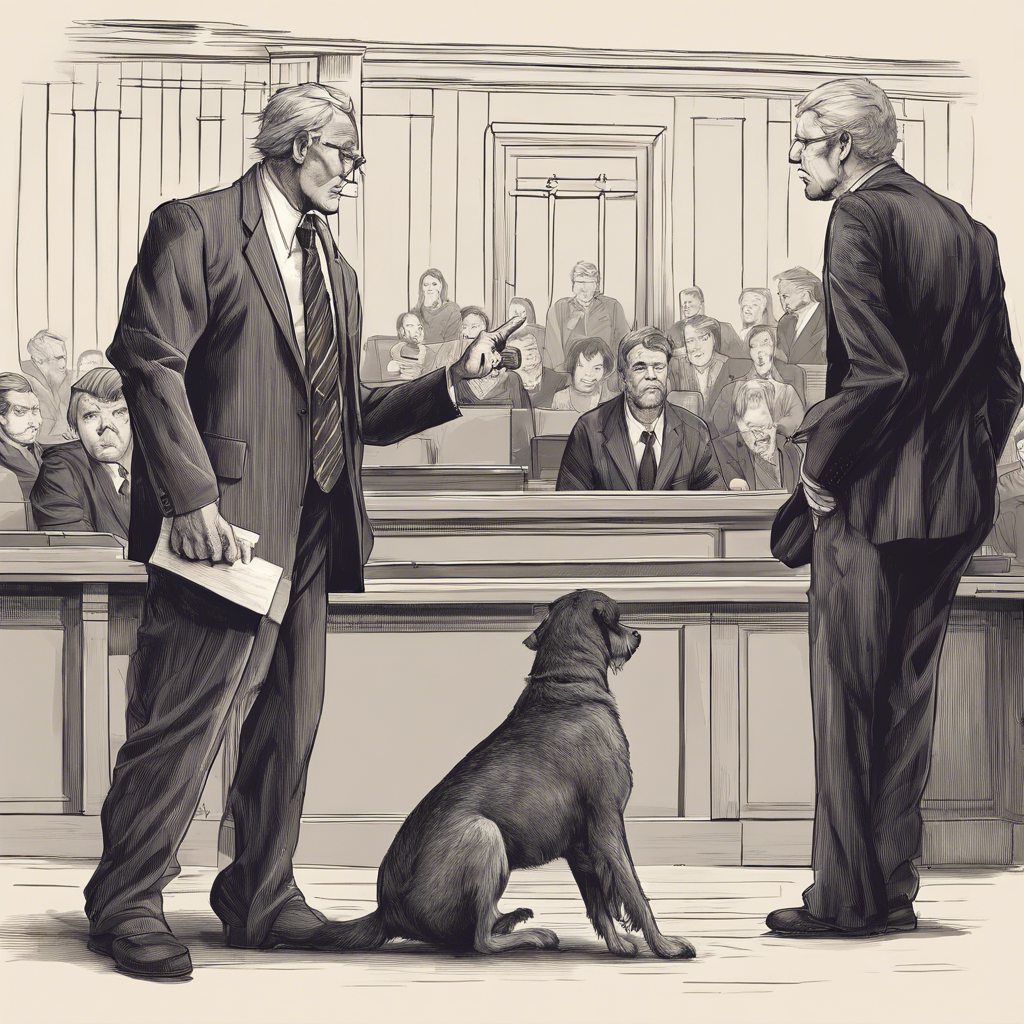
    A dog on trial in a courtroom

    Last time, in Part 1, we went over how, after a trial in 2021 in the Provincial Court of British Columbia, Mr. Ian Sisett was convicted of an offence against the Responsible Dog Ownership Bylaw of the Regional District of Central Okanagan and fined $1,000.  To be precise, he was convicted of causing or permitting Charlie to become a dangerous dog contrary to Section 36 of the bylaw, and this conviction was due to an incident which occurred on January 29th, 2020.  In that incident, Mr. Sisett had been exercising Charlie off-leash on the field of a college campus in Kelowna, British Columbia when Charlie had bitten and caused serious injuries to a smaller dog named Spike, owned by a Ms. Melanie Michaels.

    Unsatisfied with the outcome of the trial, Mr. Sisett decided to appeal his conviction.  The appeal was filed, and, in the spring of 2022, heard before Justice G.P. Weatherill of the Supreme Cout of British Columbia.

    For the appeal, Mr. Sisett enumerated multiple grounds on which he believed his conviction should be overturned.  As he had during his original trial, Mr. Sisett alleged that the Regional District of Central Okanagan, and its animal control officer and prosecutor, were biased against him.  In addition to that, he also alleged that Ms. Michaels and the Judicial Justice of the Peace (or JJP for short) who had presided over his original trial, were also biased.

    Mr. Sisett asserted that, during his trial in the Provincial Court, the JJP had admitted evidence that should have been inadmissible, had not allowed him to cross-examine witnesses or to produce evidence to rebut witness evidence.  He further argued that he had not been given enough time to prepare for his trial and, when he had requested an adjournment, the JJP had denied his request.

    All these arguments as to the unfairness of the trial, or bias against Mr. Sisett, were rejected by Justice Weatherill when hearing the appeal.  However, that was not the end of the matter, for there were additional grounds for appeal put forward by Mr. Sisett.

    Mr. Sisett suggested that the animal control bylaw was unfair in that it allowed for a dog to be deemed a dangerous dog for only one incident of aggressive behaviour; i.e. one bite.  He further argued that allowing an animal control officer to decide to declare a dog to be dangerous after only hearing from a couple of witnesses was authoritarian and over-reaching.  However, in response, Justice Weatherill dismissed these arguments, saying it was not up to the court to rewrite the bylaw to address these things that Mr. Sisett took issue with.

    Justice Weatherill then went over the key rulings of the Judicial Justice of the Peace from the trial, to determine whether they stood up to scrutiny.

    To begin with, Justice Weatherill looked at the decision which had been reached by the animal control officer, and then afterwards by the Provincial Court, that Charlie the Poodle was a dangerous dog.  He examined the definitions for the term “dangerous dog” found in the bylaw and in the provincial statute, known as the Community Charter.  He concluded that, based on these laws, it was proper for both the animal control officer and the JJP to have determined Charlie to be a dangerous dog.

    Both the bylaw and the Community Charter have similar criteria for deciding whether a dog can be classified as dangerous, including whether it has caused serious injury to another animal.  In the case of Charlie, Justice Weatherill confirmed that he had done so. 

    Charlie had picked up Spike in his jaws and shaken him violently, breaking Spike’s jaw and molar and leading to the need for two surgeries and veterinary treatment costing over $6000.  Even after the surgery and treatment, Spike had been left with a permanently twisted jaw, meaning he could now only eat soft food.

    As the JJP presiding over the trial had concluded, Justice Weatherill was satisfied that Charlie was responsible for these injuries.  This was despite Mr. Sisett’s attempts at trial to argue that something or someone else may have caused these injuries; for example, perhaps they had been caused by Ms. Michaels herself, since she had been kicking during the incident, in an attempt to fend off Charlie and get him to release her dog.

    Having ruled that the finding of Charlie to be a dangerous dog was justified, Justice Weatherill then went on to look over whether the JJP at the trial had been right to find that Mr. Sisett had “caused or permitted” Charlie to become dangerous.  This was the foundation of the conviction, because the charge had been that Mr. Sisett had violated section 36 of the bylaw, which read: “No person shall cause or permit his or her dog to become a Dangerous Dog.”

    Here, at trial, the JJP had ruled that Mr. Sisett had been responsible for Charlie becoming dangerous because he had failed to exercise due diligence to prevent this.  He had pointed out that, at the time of the incident, he had been letting Charlie run off leash, even though this had been prohibited by the animal control bylaw.  The JJP had expressed his belief that, if Charlie had been on leash as the law had required, this whole unfortunate affair would never have occurred.

    Justice Weatherill opined that, although the JJP may be right that keeping Charlie on leash as he was supposed to would’ve avoided the injuries to Spike, this was not what Mr. Sisett had been charged with.  He had not been charged with allowing his dog off leash, but rather with causing or permitting the dog to become dangerous.

    In order for someone to cause or permit their dog to do something, or become something, Justice Weatherill ruled that there needed to be evidence that the person either actively participated in causing the thing or, at the very least, had knowledge of the thing being possible and didn’t prevent it.  Since there was no evidence that Mr. Sisett had actively encouraged his dog to be aggressive, and no evidence he knew the dog had aggressive tendencies, there was no proof he had caused or permitted the dangerous behaviour.  Consequently, on May 19th, 2022, Justice Weatherill ruled that Mr. Sisett’s conviction must be overturned and his $1000 fine nullified.

    And there ends Part 2 of this case, but its not quite the end of the story, because there would be another incident and another legal case involving Charlie and his family.  If you would like to hear this third and final tale, please check out Part 3 of the Case of the Problematic Poodle.

    SOURCES:

    Community Charter, SBC 2003, c 26. https://canlii.ca/t/5660d

    Michaels, K. (2022, May 23). No evidence Kelowna man caused dog to become dangerous: B.C. Supreme Court. Global News. https://globalnews.ca/news/8863694/kelowna-dangerous-poodle/

    Potenteau, D. (2020, February 8). Kelowna woman seeking video help after pet dog allegedly attacked by poodle. Global News. https://globalnews.ca/news/6526240/kelowna-pet-dog-attacked-poodle/

    Regional District of Central Okanagan Responsible Dog Ownership Bylaw No. 1343, 2014 (Consolidated). https://www.rdco.com/en/your-government/resources/Bylaws/BL1343-Consolidated-Regulate-License-Control-Responsible-Dog-Ownership-2023.pdf

    R. v Sisett (2021, July 12), Kelowna M-1 4908-1 (BCPC). https://govlaw.ca/wp-content/uploads/2023/06/Regina-v-Sisett-Reasons-for-Judgment-Filed-July-12-2021.pdf

    R. v Sisett, 2022 BCSC 841 (CanLII). https://canlii.ca/t/jpbfh

  • The Case of the Problematic Poodle – Part 3

    Written by Michael Tillmann in An Interesting Case

    The final entry in our three part blog series exploring legal cases related to a Poodle named Charlie and his owners, and how they repeatedly came into conflict with other persons, animals and the law.

    April 12, 2024 · 9 min read

    The Case of the Problematic Poodle - Part 3

    Today’s interesting case is the third in our series of blogs for the Case of the Problematic Poodle.

    In Part 1 we covered the incident in January 2020 involving the adult standard Poodle known as Charlie, owned by Ian and Marguerite Sisett, which occurred in Kelowna, British Columbia. In that incident, Charlie had bitten and caused serious injury to a small dog named Spike, owned by a Ms. Melanie Michaels, and this had led an animal control officer working for the Regional District of Central Okanagan to issue Mr. Sisett a $1000 ticket for allegedly violating the Regional District’s animal control bylaw. Mr. Sisett had disputed this ticket but, after a trial in the Provincial Court, it had been upheld and Mr. Sisett had been convicted of violating Section 36 of the bylaw, which made it an offence for a person to “cause or permit” a dog to become dangerous.

    Following that, in Part 2, we went on to explore how Mr. Sisett had appealed his conviction to the Supreme Court of British Columbia. On the appeal, Mr. Sisett had been successful at having his conviction and the $1000 ticket quashed, because the lower court had applied the wrong legal test. The Provincial Court had equated the fact that Mr. Sisett had let his dog Charlie run off leash (which was prohibited by the bylaw) with causing or permitting the dog bite incident and the Supreme Court ruled this was legally incorrect. Although the Supreme Court did not dispute that Charlie met the definition of a dangerous dog, they found that, to be guilty of causing or permitting this dangerous condition, a person must actively participate in causing it or, at least, know of the possibility of it occurring and fail to prevent it. Since there was no evidence that Mr. Sisett had encouraged the aggressive behaviour, or knew that Charlie had aggressive tendencies, the Supreme Court had found no basis for a guilty verdict and therefore overturned the conviction.

    That was not the end of the legal disputes involving Charlie and the Sisetts though. In the summer of 2021, before the appeal of Mr. Sisett’s $1000 ticket had even begun being heard by the Supreme Court, there would unfortunately be another incident involving Charlie which drew the attention of the authorities and the legal system.

    In July 2021, Danielle Dorosh decided to go on vacation with her family in the city of Kelowna, British Columbia. She rented a home in the city to stay in for a week during her vacation and brought along her Yorkshire Terrier named Nahla. This rental home happened to be next door to the Sisett residence.

    After arriving at her vacation rental, Ms. Dorosh saw that the Sisetts’ three Poodles would run towards the fence separating the two properties, in a manner that she considered unfriendly. However, nothing further occurred at this time.

    Later, on July 18th, 2021, as Ms. Dorosh and her family were in the process of packing up to leave the house, she turned to find that her small dog Nahla was now in the yard of the Sisett property and Charlie had grabbed onto Nahla with his jaws and was shaking her back and forth. Ms. Dorosh jumped over the fence and rushed over to her dog to free her from Charlie’s jaws, which she succeeded in doing. Unfortunately, in the process, Ms. Dorosh did suffer some scrapes and bruises and, during the chaos, Nahla bit Ms. Dorosh on the face, likely due to panic. Nahla also suffered some serious lacerations herself from the incident.

    Following this incident, the Regional District of Central Okanagan and its animal control officers took enforcement action, seizing Charlie the Poodle under authority granted by Section 49 of the provincial law known as the Community Charter. A law which, among other things, authorizes animal control officers to seize dangerous dogs in certain circumstances to protect public safety.

    They also laid a total of seven charges against Mr. Sisett for alleged violations of the Community Charter and the Regional District’s Responsible Dog Ownership Bylaw, which can be summarized as follows:

    1. On January 20th, 2020, that Mr. Sisett caused or permitted Charlie to seriously injure another dog while in a public place, contrary to Section 49(1)(b) of the Community Charter. Note this charge refers back to the incident discussed in Part 1 of our series, where Charlie injured the dog named Spike, owned by Ms. Michaels. Mr. Sisett had been issued a $1000 ticket for this incident back in 2020 but it had eventually been thrown out after an appeal to the Supreme Court of BC in 2021.
    2. On March 1, 2021, that Mr. Sisett failed to obtain a dangerous dog licence for Charlie as required by Section 11 of the Responsible Dog Ownership Bylaw.
    3. On or about July 10th to July 18th, 2021, Mr. Sisett caused or permitted Charlie to become a nuisance dog contrary to Section 34 of the Responsible Dog Ownership Bylaw. This was based on the allegation that Charlie was charging the fence between the Sisett property and the vacation rental property next door, as it was alleged this made him a nuisance dog as defined in the bylaw.
    4. On or about July 18th, 2021, Mr. Sisett did not keep Charlie in a locked enclosure as required for dangerous dogs under Section 39(2) of the Responsible Dog Ownership Bylaw.
    5. On or about July 18th, 2021, Mr. Sisett caused or permitted Charlie to become likely to become deemed likely to kill or injure a person or domestic animal, contrary to Section 49(1)(c) of the Community Charter.
    6. On or about August 19th, 2021, Mr. Sisett did not have a dangerous dog warning sign posted on his property as required by Section 40 of the Responsible Dog Ownership Bylaw.
    7. On or about August 19th, 2021, Mr. Sisett did not have Charlie implanted with a microchip as required for dangerous dogs under Section 41 of the Responsible Dog Ownership Bylaw.

    In January 2023, Mr. Sisett went to trial in the Provincial Court of British Columbia before Judge A. Tam.

    At the very beginning of the trial, the judge found there was no evidence to support the possibility of a conviction on two of the seven charges because, the sections in the Community Charter that were cited as the basis for those were not actually violations a person could be charged with. Rather, those sections were simply clauses which set out definitions for and procedures for dealing with dangerous dogs, including the procedure for having a court order the destruction of a dangerous dog.

    The lawyer representing the Regional District of Central Okanagan as its prosecutor explained that it had not actually been intended to have a punishment imposed on Mr. Sisett for those counts, but rather they were asking the Provincial Court to declare Charlie to be a dangerous dog under those sections and possibly order the animal to be destroyed. Mr. Sisett expressed surprise at hearing this, stating it had not been made clear to him that this is what the Regional District was asking for. Based on the way the court document was written, Mr. Sisett stated he thought these two counts were like the other five, asking for a sentence to be imposed on him, not his dog.

    Judge Tam agreed with Mr. Sisett’s arguments and ruled that the way the prosecutor had written the two counts into the document with the other five was confusing and failed to give adequate notice to Mr. Sisett of what was being asked for. Consequently, these two of the seven counts were dismissed, and the court went on to deal with the remaining five counts against Mr. Sisett.

    In the trial of these five other counts, Mr. Sisett raised some arguments that he had at his earlier trials, namely that his prosecution by the Regional District and its staff was an abuse of process and unfair. He also argued that his dog Charlie was not a danger to the public and did not deserve to be labeled as such.

    Judge Tam rejected Mr. Sisett’s argument that Charlie was not a dangerous dog. He pointed out that, back in 2020 after the first incident involving Charlie, an animal control officer had served Mr. Sisett with a notice designating him a dangerous dog. He further pointed out that, if Mr. Sisett wanted to challenge that designation, the proper course of action was to file an application for judicial review of the officer’s decision, not to bring it up in the middle of a trial. Since the proper process had not been followed, he would not consider overturning the animal control officer’s decision in 2020 to designate Charlie as a dangerous dog.

    Judge Tam also went on to state, though he was not required to do so, he was satisfied that Charlie qualified for the designation as a dangerous dog under the law and that the animal control officer was justified in making that designation. He stated that, despite Mr. Sisett’s claims that Ms. Michaels may have accidentally injured her own dog when she was kicking at Charlie during the incident in 2020, the logical conclusion was that Charlie was the one responsible for the injuries. He also clarified that, although Mr. Sisett had been successful in getting his $1000 ticket from that incident later thrown out, that was not because Charlie was not dangerous, but only because the accusation in the ticket (i.e. that Mr. Sisett had caused or permitted Charlie to become dangerous) had no evidence to support it.

    Respecting Mr. Sisett’s allegations that the prosecution was an abuse of process and motivated by a desire to cause him financial and psychological harm, Judge Tam also declined to endorse Mr. Sisett’s arguments. He said he found no facts to back up these accusations against the Regional District, its animal control officer or prosecutor.

    On the second charge in the list, that of Mr. Sisett not purchasing a dangerous dog licence for Charlie, Judge Tam convicted Mr. Sisett. He said he didn’t find Mr. Sisett’s arguments persuasive that it was a minor and trivial oversight, noting that he had purchased the licence a year late and only after being reminded by the animal control officer.

    On the third charge, which accused Mr. Sisett of causing or permitting Charlie to become a nuisance dog, Judge Tam found Mr. Sisett not guilty. The charge was based on the testimony of Ms. Dorosh who stated she witnessed the Sisett dogs charging at the fence, which would qualify as nuisance behaviour under the bylaw. However, there were three problems that the judge had with this: 1) he was not satisfied that Ms. Dorosh had sufficiently identified Charlie as one of the dogs running at the fence; 2) he was not satisfied that the charging at the fence had happened repeatedly (which was required to meet the bylaw definition) and 3) he was not satisfied there was evidence to prove Mr. Sisett had “caused or permitted” the behaviour.

    For the fourth of the seven counts, which charged Mr. Sisett with failing to keep Charlie in an enclosure as required under the bylaw for dangerous dogs, the judge convicted Mr. Sisett. Indeed, Mr. Sisett himself admitted to Charlie not being in an enclosure on the day in question, saying that he didn’t believe he should be locked up in a cage because that was cruel.

    For the sixth charge, which alleged Mr. Sisett had not posted a dangerous dog warning sign as required by the bylaw, the judge noted Mr. Sisett had in fact put up a sign, but the sign in question did not meet the specifications set out in the bylaw. Instead, it was a sign which displayed a cartoon caricature of an animal and bore the phrase “Beware Vicious Beast.” Consequently, Judge Tam convicted Mr. Sisett on this charge as well.

    On the final charge, that of failing to implant Charlie with a microchip as required by the bylaw, the judge also found Mr. Sisett guilty, noting Mr. Sisett admitted to not having done so and had failed to provide any defence.

    The trial was now over. Out of the seven counts originally charged against Mr. Sisett, two had been dismissed before trial for lack of evidence, he had been acquitted on one and he had been convicted on the remaining four. Some time went by, and, in March 2023, Judge Tam passed sentence on Mr. Sisett for the offences he had been convicted of.

    In total, Judge Tam imposed a fine of $4000 for the four offences and ordered Mr. Sisett to pay the Regional District $7000 to cover its legal costs. Additionally, the judge imposed a restitution order requiring Mr. Sisett to pay Ms. Dorosh $1000 for the injuries to her dog and herself. Finally, the court also imposed an order on Mr. Sisett which directed him to retain a dangerous dog licence as required by the bylaw, to microchip Charlie within 15 days, to put up a proper warning sign that met the requirements of the bylaw within 15 days and to either have Charlie’s enclosure inspected and approved by animal control officers within 15 days or, if a new enclosure needed to be installed, to install it within 45 days and then have it inspected and approved by animal control officers within 15 days after that.

    And so, there ends our series on Charlie the Poodle and the Sisetts. So, what lessons can be drawn from this saga which stretched over years?

    I think it highlights that having a pet is a considerable responsibility, which can have significant legal consequences if things go wrong. It reinforces that, if you’re going to take responsibility for having custody of another living creature, you need to always be mindful of how that animal, and other persons and animals, are affected and exercise due diligence. This is both for legal reasons and ethical reasons. Having a pet is not something to be entered into lightly.

    I honestly wish Charlie the best and hope that in future he and the Sisetts can avoid any further troubles, both for their own sake, and for the sake of other persons and creatures who might be harmed.

    SOURCES:

    Community Charter, SBC 2003, c 26. https://canlii.ca/t/5660d

    Johansen, N. (2023, April 28). Kelowna man ordered to pay $12,000 over dangerous dog bylaw offences. Castanet. https://www.castanet.net/news/Kelowna/423689/Kelowna-man-ordered-to-pay-12-000-over-dangerous-dog-bylaw-offences

    Regional District of Central Okanagan Responsible Dog Ownership Bylaw No. 1343, 2014 (Consolidated). https://www.rdco.com/en/your-government/resources/Bylaws/BL1343-Consolidated-Regulate-License-Control-Responsible-Dog-Ownership-2023.pdf

    Regional District of Central Okanagan v. Sisett, 2023 BCPC 47 (CanLII). https://canlii.ca/t/jw601

    Regional District of Central Okanagan v. Sisett, 2023 BCPC 100 (CanLII). https://canlii.ca/t/jx8rd

    Regional District v. Sisett, 2023 BCPC 75 (CanLII). https://canlii.ca/t/jwvxb

  • The Case of the Driveway that was a Highway

    Written by Michael Tillmann in An Interesting Case

    This is the Case of the Driveway that was a Highway, or, to use its correct legal name, the case of British Columbia v. Querin. It is a case that revolves around a property dispute between two neighbours who disagreed over a stretch of road that both used to access their homes, with one arguing it was a private driveway and the other arguing that it was a public road. The dispute escalated, with one neighbour blocking the other from being able to access their property and ended up drawing in the provincial government. The case was decided in the Supreme Court of British Columbia in 2023 but the story begins decades earlier.

    March 29, 2024 · 8 min read

    Beneath a cloudy sky, a long gravel road passes through flat farm fields towards the horizon.

    Today we will investigate another interesting case, the Case of the Driveway that was a Highway, or, to use its correct legal name, the case of British Columbia v. Querin. It is a case that revolves around a property dispute between two neighbours who disagreed over a stretch of road that both used to access their homes, with one arguing it was a private driveway and the other arguing that it was a public road. The dispute escalated, with one neighbour blocking the other from being able to access their property and ended up drawing in the provincial government. The case was decided in the Supreme Court of British Columbia in 2023 but the story begins decades earlier.

    In 1991, Mr. Curtis Querin purchased a parcel of land in a rural area of northeastern British Columbia, just outside the village of Pouce Coupe. Mr. Querin and his wife, Deanne Querin, then proceeded to build a home and live on the property. At the time Mr. Querin made his purchase, there already existed a roadway which crossed over the property, providing access to their new homesite. Other landowners in the area, and some members of the public looking for places to ski or hunt, would sometimes use the road as well.

    When the Querins took ownership of the land in 1991, the neighbouring property to the north was owned by the Callahan family, although they did not live on the land. It was not until 1995, when Dale and Barbara Callahan took possession of the property to the north of the Querins, that a house began to be built on that land. Over the course of the next year, the Callahans constructed their home on the land, living in a motorhome in the meantime until it was ready.

    For twenty years, from 1995 to 2015, the Callahans accessed their land using the roadway which crossed over the Querin property. It was used daily by the Callahans, to go to and from work, and by their family and friends who came to visit them. During this time, the Querins did not object to this use of the road and the Callahans stated they were under the impression that the road was open to the public. Other persons in the area would also sometimes use the road too, though it was mostly the Querins and the Callahans.

    Problems began to arise in 2015, when the Querins became aware of plans by the Callahans to subdivide their property. The Callahans intended to divide their property up into smaller parcels, keeping the piece of land their house was located on and selling the others. As they believed it to be a public road, the Callahans intended that the road crossing the Querin property would be used by the people who purchased these new lots.

    The Querins were adamantly opposed to this plan to use the roadway to access these new lots, fearing the increase in traffic would negatively impact them. As far as they were concerned, the road that crossed over their land was their private driveway. They had been allowing the Callahans to use it, but they did not want to see a multitude of new users. To express their displeasure with the Callahans’ plans and reinforce their claim of ownership, the Querins posted signage reading “Keep Out” and “Private Drive” alongside the roadway.

    In 2017, the dispute reached a whole new level when Mr. Querin installed several barriers. A locking gate was constructed at the eastern end of the roadway and a wall of concrete blocks was laid across the western end, blocking entry by vehicles to the Callahan property entirely, although still allowing access to the Querins’ house. This was particularly concerning to the Callahans because Mrs. Callahan had a heart condition, and they were worried this would result in emergency services being unable to reach them.  In fact, on the day the concrete blocks were laid down, Mrs. Callahan missed a medical appointment she had scheduled because she was unable to exit from her property due to the barrier.

    The Callahans took their concerns to the Royal Canadian Mounted Police (the RCMP) and the provincial Ministry of Transportation and Infrastructure, asserting that the road was public and asking for their assistance in having the blockages removed. In response, the RCMP stated the dispute between the two neighbours was a dispute over property rights and not a criminal offence, thus refusing to get involved. The Ministry also was not willing to compel the Querins to remove their barriers, although they did help the Callahans build an alternate road to enter their property via a route that did not cross the Querin property. However, the Callahans found this alternate road inadequate because it would turn to impassable mud in the spring, and it also was not in good enough condition to allow delivery trucks carrying water or propane to reach the Callahan property.

    In January 2018, the Querins decided to appeal to a higher authority and wrote a letter to the British Columbia Attorney General, again arguing the roadway across the Querin property was public and asking for help. After this, the Ministry of Transportation and Infrastructure acted, having employees and contractors attend and remove the concrete blocks and gate that obstructed access. That same year the provincial government also began a court action in the Supreme Court of British Columbia seeking a declaration that the road was a public road and not a private driveway, as the Querins claimed. Additionally, the provincial government sought, and received, a temporary injunction from the court prohibiting the Querins from blocking the road again until the court case regarding ownership was settled.

    The case then began winding its way through the legal system, slowly, as cases often do. While it was navigating its way through the court, the dispute between the two neighbouring families continued to simmer away and it flared up again in the summer of 2022. In July 2022, Mr. Querin installed two posts on either side of the disputed road, approximately 10 to 11 feet apart from one another. Mr. Querin stated the reason for doing this was because Mr. Callahan had been driving his loader and tractor onto the Querins’ property to turn around and he wanted to stop this practice; and he argued there should be no problem with it because the law stated vehicles wider than that weren’t supposed to be on public roads anyways.  Unfortunately, these poles had the effect of making the roadway too narrow for the Callahans to drive their motorhome through; something they found out to their dismay when they returned from vacation in the summer of 2022.

    Eventually, in the fall of 2023, the case went before Justice F. Matthew Kirchner of the Supreme Court of British Columbia for a decision on whether the road in question was public (or a “highway” if one is to use the correct legal terminology for a public road in British Columbia law) or a private driveway.  If it was a highway, then the Callahans could continue using it to access their property; indeed, anyone could use it. If it were a private driveway on private land, as the Querins insisted, then the Callahans would be out of luck.

    The provincial government of British Columbia’s legal team took the position at trial that the road was indeed a highway under British Columbia law, and they based this argument on Section 42 of the Transportation Act. It was a clause of the provincial legislation which had been in existence for many decades, albeit in slightly different forms. It declared that, if the provincial government spent money on a road located on private land – and that road was travelled by the public – then the road automatically became publicly owned.

    Arguments and submissions were made about whether enough public funds had been spent on the road, and whether enough members of the public had travelled on the road, to trigger Section 42 and thereby make it a highway. The Querins argued that any work done by the province on the road was minor and, in fact, it was Mr. Querin who had done the bulk of the work to maintain the road. However, the province was able to produce records showing various government employees and contractors had done work to build and/or maintain the road for decades and, despite some irregularities with these records, the justice was satisfied they proved that significant government funds had been expended on the road.

    With regards to whether enough members of the public had traveled the road to make it public, the case was a little less clear. The justice remarked that, despite some occasional usage by members of the public, most of the road users had been either the Querins or their visitors, up until the 1990’s when the Callahans had moved in on the neighbouring lot. From then on, the Callahans and their various guests had been using the road daily. This was, in the justice’s opinion, sufficient to meet the threshold of making it public, although he noted the case would have been stronger if there was a greater diversity of persons who used the road regularly.

    Having made these findings, Justice Kirchner made a declaration that the road was a public highway within the meaning of Section 42 of the Act and therefore belonged to the provincial government. Consequently, the Callahans and all other members of the public could continue to use this throughfare. However, the justice did refuse to grant the provincial government’s request to order the Querins to pay for the costs of removing the concrete block wall and gate they had built in 2017. The justice also declined to make an order declaring how wide the public highway was – the province had requested that he declare the publicly owned road to be a two-lane one – and instead the justice left that matter unresolved for the time being.

    And there ends our story of how what, on its surface, looked to be a private driveway but was found to be a highway. It was a contentious one, stirring up animosity between neighbours, and resulting in the government having to step in to reach a resolution. And surprisingly, it’s a story that is more common than one might think.

    The British Columbia Ombudsperson – an official responsible for investigating complaints made against the provincial government and other public bodies in the province – recently released a report called “On the Road Again: Fixing a Longstanding Injustice in Section 42 of the Transportation Act” detailing how disputes of this kind have been occurring for decades. The report criticized how Section 42 of the Transportation Act has been used over the years, creating scenarios where property owners end up losing portions of their land to the government without even realizing it and fueling uncertainty over who owns what. Amongst other recommendations, the Ombudsperson has called on the government to take action to resolve this uncertainty over which roads actually are public by creating a public registry of roads that they believe have become public due to Section 42, and also by registering this information against the land titles of the properties in question.  The government has accepted five of the seven recommendations made by the Ombudsperson, but the final two, regarding the public registry and the registry against land titles, may or may not be implemented.

    SOURCES:

    British Columbia v Querin, 2023 BCSC 1994 (CanLII). https://canlii.ca/t/k15d7

    British Columbia v Querin, 2024 BCSC 197 (CanLII). https://canlii.ca/t/k2ql8

    Office of the Ombudsperson (British Columbia). (2024). On the Road Again: Fixing a Longstanding Injustice in Section 42 of the Transportation Act (Special Report No. 55). https://bcombudsperson.ca/assets/media/OMB-Roads_Report_WEB.pdf

    Summer, T. (2023, November 22). It’s a public road, not a driveway, B.C. justice rules. CTVNews. https://bc.ctvnews.ca/it-s-a-public-road-not-a-driveway-b-c-justice-rules-1.6655891

    The Canadian Press. (2024, March 5). B.C. ombudsperson calls rules that allow private roads to be made public ‘unjust’. Energeticcity.ca. https://energeticcity.ca/2024/03/05/b-c-ombudsperson-calls-rules-that-allow-private-roads-to-be-made-public-unjust/

    Transportation Act, SBC 2004, c. 44. https://canlii.ca/t/566fd

    Transportation Act Regulation, BC Reg 546/2004. https://canlii.ca/t/563zn

  • The Case of Disinformation and the Deleted Word

    Written by Michael Tillmann in An Interesting Case

    This is the interesting case of Disinformation and the Deleted Word, or to use its correct legal name, the case of the Canadian Constitution Foundation v. Canada (Attorney General). It is the story of how, when the government decided to rewrite the Canada Elections Act, they opened a controversy by deleting one word. This controversy touched on such important issues as disinformation, election integrity and freedom of speech and it concerned people so much that they ended up mounting a constitutional challenge of the newly rewritten law, asking the courts to strike down the new Act as unconstitutional.

    March 15, 2024 · 7 min read

    The Case of Disinformation and the Deleted Word

    This is the interesting case of Disinformation and the Deleted Word, or to use its correct legal name, the case of the Canadian Constitution Foundation v. Canada (Attorney General)

    It is the story of how, when the government decided to rewrite the Canada Elections Act, they opened a controversy by deleting one word.  This controversy touched on such important issues as disinformation, election integrity and freedom of speech and it concerned people so much that they ended up mounting a constitutional challenge of the newly rewritten law, asking the courts to strike down the new Act as unconstitutional.

    The case was decided by the Ontario Superior Court of Justice in 2021, but the story begins three years earlier.

    In 2018, the federal government of Canada decided to update its election laws.  This was partly in response to concerns about election interference that had been raised in recent years.  There had been stories in the media about foreign agents attempting to influence the course of Canadian federal elections and there had been calls made for the authorities to respond.  There was concern about persons influencing elections by spreading misinformation and disinformation.

    There was also a desire to update some other elements of election law, to change spending limits and the like, and to reverse some election rules that a previous government had brought in which were criticized as being unfair.  However, that’s a topic we won’t get into for now, as our story is focused on misinformation and disinformation.

    So, in response to all the concerns mentioned, the federal government introduced Bill C-76 into the Parliament of Canada and it was passed and enacted into law in December 2018.  One of the changes this bill made was to amend the wording of Section 91 of the Canada Elections Act.  This was the section of Canada’s federal election law which made it an offence to spread false news about political candidates.

    It wasn’t a new idea to prohibit false information aimed at influencing elections.  In fact, there had been a section in the federal election law which banned people from doing so since 1908.  This amendment sought to make the provision more effective by specifically naming the types of false information prohibited. 

    The previous version of Section 91 had merely stated that it was unlawful to spread false information about a political candidate’s “character or conduct.”  However, the new amended version listed out various topics which it would be unlawful to spread false information about, such as false statements claiming a person had been charged with, or was under an investigation for, an offence and false claims about a person’s place of birth, citizenship, etc.  Additionally, the new law banned not only false statements about a candidate in an election but also about other persons, such as the leaders of parties and public figures associated with political parties.

    There was another difference between the pre-2018 law and the new amended version too.  In the previous version, the law had been worded so it was an offence to spread false information “knowingly.”  However, in the new version this word was deleted. 

    When the draft of the law was being discussed in Parliament, politicians had inquired about this change but had been told it was only a minor adjustment, or a housekeeping matter.  A lawyer and policy advisor representing the federal government at the parliamentary hearings suggested that it was still implied in the law that a person had to knowingly spread false information to be guilty, even if the word had been deleted, and so persons who unknowingly spread incorrect information would not be liable.

    Despite these statements from the federal authorities that persons who unwittingly communicated misinformation would not be targeted for enforcement, some persons were not reassured.  Criticisms were raised that the law would make many people hesitate to discuss and debate the qualities of political figures publicly for fear of accidentally running afoul of the law.  Indeed, a representative of one Canada’s prominent political advocacy groups, the Canadian Taxpayers Federation, stated they had curtailed their communications campaign in the 2019 federal election for fears of violating the new law.

    In light of these criticisms of the law, it was probably predestined that someone would challenge it in court and the Canadian Constitution Foundation did just that in September 2019.  A registered charity dedicated to advocating for rights protected in the Canadian Constitution, the group launched a legal action seeking to have Section 91 of the Canada Elections Act struck down as unconstitutional.  They were supported in this effort by PEN Canada, another charity which advocated on behalf of freedom of expression for writers.

    The case ended up being heard before Justice Davis of the Ontario Superior Court of Justice.  As the hearing unfolded, the Canadian Constitution Foundation argued that Section 91 violated the Canadian Constitution and should be struck down on those grounds.  To be precise, they argued it violated Section 2 of the Canadian Charter of Rights and Freedoms, which is a part of the Constitution, and which guarantees persons several freedoms, including freedom of expression.

    The legal team representing the Attorney General of Canada, which opposed the application by the Canadian Constitution Foundation, admitted that the law restricted freedom of expression somewhat, but invoked Section 1 of the Charter which allows for limits to be placed on rights as long as the limits are reasonable and demonstrably justifiable in a free and democratic society.  The Attorney General’s position was that the law was seeking to achieve an important goal, the prevention of disinformation in elections, and it had been crafted in such a way that it was a reasonable limit.

    Arguments and counterarguments were then presented on the question of to what degree the law impaired freedom of expression, and whether the impairment was small enough to constitute a reasonable limit.  This led to scrutiny of the exact wording of the section and the Canadian Constitution Foundation made the point that, since the word “knowingly” had been removed in the new version of the law, it had far too large of an impact on the freedoms of citizens to express themselves.  They argued that, due to the word being deleted, it was now possible for persons to be convicted of a crime for accidentally stating falsehoods that they believed to be true, and this was not a reasonable limit.

    The Attorney General’s position was the same as the federal government had presented before when the law was being amended.  That is to say, even thought he word “knowingly” had been taken out, it made no difference, because it was still implied that a person could only be convicted if they knowingly made a false statement.  They presented evidence in support of this position, although some of the evidence was not all that helpful as it contained inconsistencies.  For example, an affidavit from enforcement officials in Elections Canada stated that, for a person to be convicted, the individual would have to knowingly make a false statement, but then later the affidavit stated that reckless disregard for the truth might also qualify.  This was a problem because recklessness and knowledge are not equivalent and so it only further muddied the waters on what standard the government intended to use for enforcement.

    In the end, Justice Davis ruled against the federal government, giving her judgment on February 19, 2021.  She found that, despite the claims of the government to the contrary, removing the word “knowingly” had changed the law and that it had lowered the standard for convicting a person.  Under this new law, a person could be convicted for unknowingly spreading falsehoods and this was too great of an impairment of a person’s freedom of expression, and it could not be justified as a reasonable limit under the Charter of Rights and Freedoms.  As a result, she issued a declaration that Section 91 was unconstitutional and that it was of no force or effect.

    Following this court decision, the federal government took action fairly quickly to respond to the law being struck down.  By April 2021, they had introduced a bill into Parliament to re-insert the word “knowingly” back into the relevant sections of the Canada Elections Act and this bill was passed into law shortly thereafter.

    SOURCES:

    Appearance on Part 4, Division 37 of Bill C-30, An Act to implement certain provisions of the budget tabled in Parliament on April 19, 2021 and other measures, Standing Senate Committee on Legal and Constitutional Affairs, 43rd Parliament. (2021) (testimony of Minister of Intergovernmental Affairs Dominic A. LeBlanc). https://www.canada.ca/en/intergovernmental-affairs/corporate/transparency/briefing-documents/parliamentary-committees/standing-senate-committee-legal-constitutional-affairs/study-bill-c-30-may-12-2021.html

    Bill C-30, An Act to implement certain provisions of the budget tabled in Parliament on April 19, 2021 and other measures, 2nd Session, 43rd Parliament, 2021. https://www.parl.ca/DocumentViewer/en/43-2/bill/C-30/royal-assent

    Bryden, J. (2018, December 10). Election reform bill passed in time for implementation in 2019 federal vote. CTV News. https://www.ctvnews.ca/politics/election-reform-bill-passed-in-time-for-implementation-in-2019-federal-vote-1.4212822?cache=

    Canada Elections Act, SC 2000, c. 9. https://canlii.ca/t/562tc

    Canadian Constitution Foundation. (n.d.). About Us – Canadian Constitution Foundation. Canadian Constitution Foundation. Retrieved February 24, 2024 from https://theccf.ca/about-us/


    Canadian Constitution Foundation v. Canada (Attorney General), 2021 ONSC 1224 (CanLII). https://canlii.ca/t/jdffc

    Democratic Institutions. (2018, December 14). Government of Canada passes Elections Modernization Act [Press release]. https://www.canada.ca/en/democratic-institutions/news/2018/12/government-of-canada-passes-elections-modernization-act.html

    Dyer, E. (2019, November 3). Watch what you tweet: New election law ‘chills speech,’ say critics. CBC News. https://www.cbc.ca/news/politics/elections-canada-section-91-2019-election-1.5345250

    Elections Modernization Act, S.C. 2018, c. 31. https://laws-lois.justice.gc.ca/eng/annualstatutes/2018_31/FullText.html

    Gaumond, E. (2021, March 16). Why a Canadian Law Prohibiting False Statements in the Run-Up to an Election Was Found Unconstitutional. Lawfare. https://www.lawfaremedia.org/article/why-canadian-law-prohibiting-false-statements-run-election-was-found-unconstitutional

    PEN Canada. (n.d.). About – PEN Canada. PEN Canada. Retrieved February 24, 2024 from https://pencanada.ca/about/

    The Constitution Act, 1982, Schedule B to the Canada Act 1982 (UK), 1982, c 11. https://canlii.ca/t/ldsx

    Thompson, E. (2021, March 14). Law prohibiting election misinformation struck down. CBC News. https://www.cbc.ca/news/politics/elections-misinformation-court-free-speech-1.5948463

  • The Case of the Huron County Witch Trial

    Written by Michael Tillmann in An Interesting Case

    This is the interesting case of the Huron County Witch Trial, or to use its correct legal name, the case of Rex v. Pollock. It is the story of Maggie Pollock, a woman from a small community in Ontario, Canada in the early part of the 20th century. It revolves around how she used allegedly supernatural skills to find missing and stolen property for people, and how those services she offered ended up seeing her prosecuted under the Criminal Code of Canada for a witchcraft-related offence.

    March 1, 2024 · 6 min read

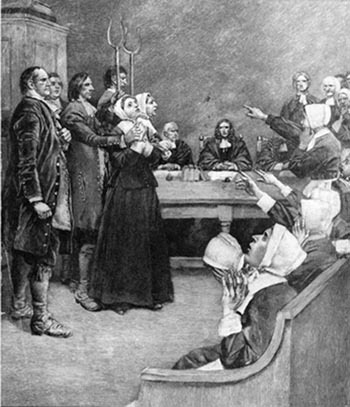
    1893 engraving depicting the Salem Witch Trials. Credit: Howard Pyle, Public Domain.

    This is the interesting case of the Huron County Witch Trial, or to use its correct legal name, the case of Rex v. Pollock.

    It is the story of Maggie Pollock, a woman from a small community in Ontario, Canada in the early part of the 20th century.  It revolves around how she used allegedly supernatural skills to find missing and stolen property for people, and how those services she offered ended up seeing her prosecuted under the Criminal Code of Canada for a witchcraft-related offence.

    The case was decided in the Appellate Division of the Ontario Supreme Court in 1920, but the events of the story began unfolding years earlier.

    In 1919, Margaret Pollock – better known as Maggie Pollock – was a woman of 40 years who resided on a farm in Morris Township in the province of Ontario.  She made a living working on the farm, which was owned by her brother, but also earned income from providing services of a rather unusual nature to the inhabitants of the region.

    You see, from an early age, Miss Pollock began to delve into the world of the supernatural.  She stated she would receive visions and communications from the spirit world.  With the assistance of these spirits, she would offer to help the people of Morris Township locate items that were stolen or lost, and in return they would show their gratitude by paying her a small sum of money.  As of 1919, it is reported that the average payment was 50 cents, which would work out to approximately $8 Canadian dollars in 2024.

    Now, offering services of this kind was controversial.  Many considered communication with spirits to be unwholesome or even sinful, but Miss Pollock asserted that it was a completely natural God given gift and she did not believe there was anything untoward about it.  Indeed, she told people she felt compelled to use the gifts she had been given to help others.

    Regardless of the origin of her talent, in the year 1919 Miss Pollock was approached by a man named John Leonhardt who was in search of some oats.  He believed that a person or persons unknown had stolen oats from his barn, and he sought out Miss Pollock so she might exercise her powers to find them.  After holding one of the man’s mitts in her hand for a time, Ms. Pollock announced that the spirits had shown her a vision of the oat theft and proceeded to give him a description of the thieves and the direction they had fled with their ill-gotten goods.  Mr. Leonhardt then paid Miss Pollock the customary 50 cents and went on his way.

    The historical records I could locate did not reveal what happened to Mr. Leonhardt or his search for the stolen oats after this, or whether the information that Miss Pollock provided was of any help to him.  Whatever may have become of the oats, it appears that someone reported Miss Pollock to the authorities, for later that year she ended up being prosecuted for committing a crime against section 443 of the Criminal Code, as it was then written, which proclaimed as follows:

    “Everyone is guilty of an indictable offence and liable to imprisonment for one year who pretends to exercise or use any kind of witchcraft, sorcery, enchantment or conjuration, or undertakes to tell fortunes, or pretends from his skill or knowledge in any occult or crafty science, to discover where or in what manner any goods or chattels supposed to have been stolen or lost may be found.”

    Brought to trial in the County Court before Judge Henry Dickinson, Miss Pollock argued for her innocence.  A Mrs. Grace Sinclair also testified on Miss Pollock’s behalf, attesting to how Miss Pollock was not fraudulent and recounting how Miss Pollock had previously helped her find a lost gold ring using her supernatural gifts.   However, this did not sway Judge Dickinson who convicted Miss Pollock of pretending to use occult knowledge to discover the whereabouts of stolen property, contrary to section 443; although the judge did agree to suspend the passing of sentence to allow her to go free while her lawyer appealed the conviction to a higher court.

    In June 1920, the appeal was taken up in the Ontario Supreme Court, sitting in the historic Osgoode Hall in Toronto.  On appeal, the lawyer representing Miss Pollock advance several arguments in her defence. 

    To start, he pointed out that many prominent persons of the day also believed in the spirit world and mentioned some by name, such as Sir Arthur Conan Doyle, the famous author of the Sherlock Holmes novels and an enthusiastic proponent of spiritualism.  He questioned whether it could really be intended for the law to prohibit occult practices when such upstanding citizens also engaged in similar behaviour.

    The defence also argued that, since Miss Pollock honestly believed in her ability to commune with spirits to gain insights on the whereabouts of lost or stolen property, that she did not have the necessary dishonest mind required for conviction.  After all, the section talked about “pretending” to practice witchcraft and it was obviously aimed at dishonest and deceptive conduct, not the actions of honest citizens who were not seeking to cheat anyone.

    Unfortunately for Miss Pollock, when Justice Orde handed down the decision of the Ontario Supreme Court, the defence arguments did not prevail.  On the point that other persons also engaged in spiritualism, the justice pointed out that the law did not prohibit people from engaging in seances or other supernatural pursuits in general, only in certain specific ones such as finding stolen or missing property.  Additionally, the justice ruled that a person could be guilty of pretending to practice prohibited occult arts specified in the law even if the person honestly believed they had such powers and had no intention to cheat anyone.

    For one thing, Justice Orde noted that the word “pretend” in section 443 was being used in an older sense of the word, which roughly equated to profess or claim, rather than being deliberately dishonest.  For another, the justice declared the court needed to look to the intentions of the lawmakers when interpreting the law and, in the eyes of the legislators, supernatural powers were not a reality.  It was the lawmaker’s intent to criminalize the act of claiming to be able to supernaturally locate property because they presumed it to be impossible and false, regardless of whether the person who made the claim knew it was false or not.  To put it another way, such occult practitioners were guilty of pretending to practice the occult even if they didn’t know they were pretending.

    According to news reports from the time, after the Ontario Supreme Court upheld her conviction, Miss Pollock did not receive any prison time.  Instead, she received a $200 fine (about $3000 in 2024 dollars) and was admonished to cease her occult property location services; although, to be clear, she could still give opinions on where property might be found, just without making mention of any supernatural sources of knowledge. 

    Interestingly, laws against pretending to practice occult arts – including a law against fortune telling – would remain on the books in Canada in some shape or form for another century.  It wasn’t until 2018, that section 365 of the Criminal Code (which was the more modern equivalent of section 443) was repealed.  Even more interestingly, a woman had been charged with violating the law only a few days before it was repealed, but that story will have to wait for another time.

    So, what are the closing thoughts about this case?  I suppose it shows how there is a long history of fear for those who practice arts that are seen as occult, and until recently the law was used to suppress these activities.  Gradually, over the centuries, the penalties became less severe – being downgraded from the death penalty that was common in centuries past to a mere fine in the case of Miss Pollock – but the fear and distrust remained.  Perhaps now we are beginning to move past such fears.  One can only hope.

    SOURCES:

    Bill C-51, An Act to amend the Criminal Code and the Department of Justice Act and to make consequential amendments to another Act, 1st Session, 42nd Parliament, 2018. https://www.parl.ca/DocumentViewer/en/42-1/bill/C-51/royal-assent

    Criminal Code, RSC 1985, c. C-46. https://canlii.ca/t/53gxz

    Harris, K. (2018, December 19). Woman charged with witchcraft just 2 days before offence scrubbed from law. CBC News. https://www.cbc.ca/news/politics/witchcraft-criminal-code-charge-1.4951071

    Lewis, K, & Murdoch, M. (2022, October 27). Double, Double Toil and Trouble: The Tale of Maggie Pollock and the Huron County Witch Trial. Huron County Museum. https://www.huroncountymuseum.ca/double-double-toil-and-trouble-the-tale-of-maggie-pollock-and-the-huron-county-witch-trial/

    nesbittkaila. (2023, February 9). Maggie Pollock & The Huron County Witch Trial. Public History in Practice. https://publichistoryinpractice.ca/2023/02/09/maggie-pollock-the-huron-county-witch-trial/

    Official Data Foundation. (n.d.a). $1 in 1919 worth $16.26 today. in2013dollars.com. Retrieved February 19, 2024 from https://www.in2013dollars.com/canada/inflation/1919?amount=1

    Official Data Foundation. (n.d.b). $200 in 1920 is worth $3,084.17 today. in2013dollars.com. Retrieved February 21, 2024 from https://www.in2013dollars.com/us/inflation/1920?amount=200

    Rex v. Pollock, 1920 CanLII 873 (ON CA). https://canlii.ca/t/jzmdh

    Schwarcz, J. (2017, March 20). The Strange Friendship Between Harry Houdini and Sir Arthur Conan Doyle. McGill Office for Science and Society. https://www.mcgill.ca/oss/article/history-you-asked/how-did-sir-arthur-conan-doyle-trick-houdini

    Woodyard, C. (2014, November 25). Occult Science and Oats: A Canadian Witch Trial. Haunted Ohio. http://hauntedohiobooks.com/news/occult-science-oats-canadian-witch-trial/

    Description: 1893 engraving of Salem Witch Trials

    Credit: Howard Pyle, Public Domain,

    via Wikimedia Commons

  • The Case of Sidewalk Snow Removal

    Written by Michael Tillmann in An Interesting Case

    This case concerns a Mr. Harold Gutovich of Vancouver, British Columbia and his prosecution for alleged failure to comply with the city’s sidewalk snow removal bylaw in January 2022.

    February 23, 2024 · 4 min read

    The Case of Sidewalk Snow Removal

    Today we have a smaller case for you.  Small but I think nonetheless interesting.  It is the case of Sidewalk Snow Removal, or to use its correct legal name, the case of R. v. Gutovich.

    This case concerns a Mr. Harold Gutovich of Vancouver, British Columbia and the condition of a sidewalk in front of a home he owned in that city on one particular day in January 2022.

    This case was decided in the Supreme Court of British Columbia in October 2023, but the subject-matter the case dealt with came into play almost two years earlier.

    In January 2022, in the City of Vancouver, someone noticed that a sidewalk in front of a home on West 16th Street was snow covered.  This was an issue because the City of Vancouver had a bylaw which imposed certain legal duties on people who owned or occupied lots of land with sidewalks adjacent to them. 

    To be precise, section 76 of Vancouver’s Street and Traffic By-law stated as follows:

    “The owner or occupier of any parcel of real property shall, not later than 10:00 a.m. every day, remove all snow and ice from any sidewalk adjacent to such parcel for a distance that coincides with the parcel’s property line and for the full width of the sidewalk.”

    Now, some may find it unfair that a private homeowner is expected to shovel snow off a sidewalk that they don’t even own (after all it is a public sidewalk), but it is in fact a common bylaw that many communities in Canada have.  The usual rationale for such bylaws is that there are so many kilometres of public sidewalks everywhere that the governments of cities and towns simply don’t have enough staff, equipment, or funds to remove snow from all of them in the winter, and so they end up passing local bylaws assigning this duty to clean sidewalks to the nearest landowner.  And this was indeed the approach that Vancouver adopted with its bylaw and, if a person failed to carry out this duty, the bylaw provided that the individual would be liable to a fine and could also potentially have the sidewalk cleaned by the city at their expense.

    Presumably, the person who observed the uncleaned sidewalk in front of this Vancouver home was aware of this bylaw and decided to report the matter, because someone ended up phoning in a complaint to the city.  In response to the complaint, Mr. Gill, an inspector contracted by the City of Vancouver, was tasked to investigate.

    Mr. Gill attended the home in question on the morning of January 9th, 2022, shortly after 10am and observed the sidewalk in front of the property still had snow on it.  He took several photographs of the sidewalk.  Later, the owner of the property, Mr. Gutovich was charged with violating section 76 of the by-law.

    The charge went to trial in the Provincial Court of British Columbia in May 2023.  The matter was dealt with by a Judicial Justice of the Peace (a JJP), a judicial officer who, amongst other duties, is assigned to preside over trials and hearings that are less serious in nature and do not require a judge.  Interestingly, according to the record, it appears that Mr. Gutovich did not appear at the trial and the only evidence presented was put forward by the prosecutor, the Crown attorney.

    At trial, the prosecution case consisted entirely of the testimony of Mr. Gill and the photographs he had taken.  The Crown’s position was that, as the photographs showed, there was still snow on the sidewalk in question and therefore the landowner had not complied with the bylaw and should be found guilty.

    However, the JJP was not convinced and commented that she could see from the photographs that at least some snow had been shoveled away, because the level of snow on the sidewalk was lower than other areas surrounding it.  She pointed out that the bylaw’s wording only stated that a landowner had to “remove” snow from the sidewalk, not “clear” it all the way down to the pavement or concrete.  She then asked the Crown attorney if there was any caselaw that would be of assistance in interpreting exactly what “remove” meant in the city’s bylaw and allowed them to go search for some while the trial was adjourned for lunch.

    When the trial resumed after lunch, the Crown attorney was not able to present any caselaw showing that the word “remove” found in the bylaw meant a person had to entirely clear a sidewalk all the way down to the concrete or pavement.  Accordingly, the JJP found that, since the meaning of the word “remove” in the bylaw was ambiguous, she would decide in favour of Mr. Gutovich.  She found the photographs showed that, although the sidewalk was not absolutely clear of snow, a significant amount of snow had been removed and therefore Mr. Gutovich had not violated the bylaw.  She also suggested that, if the City of Vancouver wanted sidewalks to be kept absolutely clear of snow, they might want to change the wording of their bylaw.

    Not content with this outcome, the prosecution appealed the case to the next higher level of court and in the fall of 2023 the appeal was heard by the Supreme Court of British Columbia.  Again, Mr. Gutovich didn’t attend the hearing, and only the Crown attorney presented arguments.  In their presentation, the Crown attorney asserted the lower court had made a number of legal and factual errors which justified overturning its decision and convicting Mr. Gutovich of the bylaw offence.

    Unhappily for the Crown, the Supreme Court of BC declined to overturn the ruling.   The Supreme Court justice ruled that he did not see grounds for overturning the decision of the Judicial Justice of the Peace, and so Mr. Gutovich was still able to avoid a fine despite the Crown attorney’s best efforts.

    SOURCES:

    City of Vancouver, By-law No. 2849, Street and Traffic By-law [Consolidated to January 1, 2024]. https://bylaws.vancouver.ca/2849c.PDF

    City of Vancouver. (n.d.). Winter maintenance on streets and sidewalks. City of Vancouver. Retrieved February 17, 2024 from https://vancouver.ca/streets-transportation/snow-removal-from-city-streets.aspx

    Halliday, I. (2023, November 3). Crown’s attempt to enforce Vancouver snow removal bylaw dismissed on appeal. CTV News. https://bc.ctvnews.ca/crown-s-attempt-to-enforce-vancouver-snow-removal-bylaw-dismissed-on-appeal-1.6631078

    Lazaruk, S. (2023, November 4). Vancouver homeowner wins fight against city hall on snow clearing bylaw ticket. Vancouver Sun. https://vancouversun.com/news/local-news/vancouver-homeowner-wins-fight-against-city-hall-on-snow-clearing-bylaw-ticket

    R. v Gutovich, 2023 BCSC 1938 (CanLII). https://canlii.ca/t/k0z66